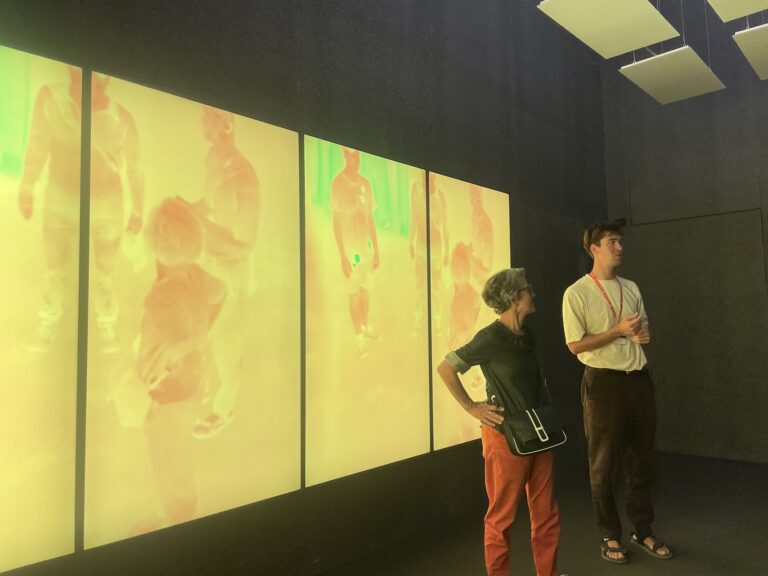
Art glass at the Biennale, amid stories of furnaces and innovations. The new chapter of the exhibition set up at Le Stanze del Vetro on the Island of San Giorgio Maggiore in Venice, titled “1932-1942 Murano Glass and the Venice Biennale,” is dedicated to the years that saw the furnaces collaborate with artists and designers such as Carlo Scarpa, Flavio Poli, Dino Martens and Mario De Luigi to present their best production to the famous Venetian institution. The new exhibition, curated by Marino Barovier, open until Nov. 23 thanks to a Project of Fondazione Giorgio Cini onlus and Pentagram Stiftung, and part of the proposals of The Venice Glass Week (read here), examines the years corresponding to the inauguration of the Venice Pavilion and the last edition of the Biennale before the interruption due to World War II. Beginning in 1932, Murano glass was present at the exhibition in a dedicated space, built specifically to house the decorative arts thanks to the synergy between the Biennale entity and the Istituto Veneto per il Lavoro. The value and quality of the so-called minor arts were thus officially recognized, and at the exhibition they were selected to be shown to the general public.

These were years of great creativity and experimentation with materials and colors, both by revisiting ancient techniques and by developing new processes. Initially, mainly light and transparent blown glass was offered along with opaque glass with intense colors, while from the mid-1930s the glass became thicker, in many cases embellished with bubbles, delicate nuances or applications of gold leaf. Thanks also to the constant renewal of this appointment with the Biennale, knowing how to seize new stimuli from time to time, the Murano furnaces presented themselves with the best production.
Indeed, the Venetian event was for the furnaces a privileged showcase and a profitable opportunity for comparison on the international level. As it was, for example, for the Ferro Toso – Barovier glassworks, later to become Barovier Toso & C., which at the Biennale exhibited glass with accentuated volumetry and unprecedented lagoon and sapphire colors, designed by Ercole Barovier, presenting also thick crystal glass with applied decorations, among which the “Rostrati” in thick crystal, made with small prisms in relief on the entire surface, destined for considerable commercial success, stand out. Also significant by Barovier are the “Superbubbles,” also made of thick crystal glass with large internal bubbles, and the “Oriente” glass series with its lively glassy fabric of polychrome crisscrossed canes and bands, embellished with silver leaf.

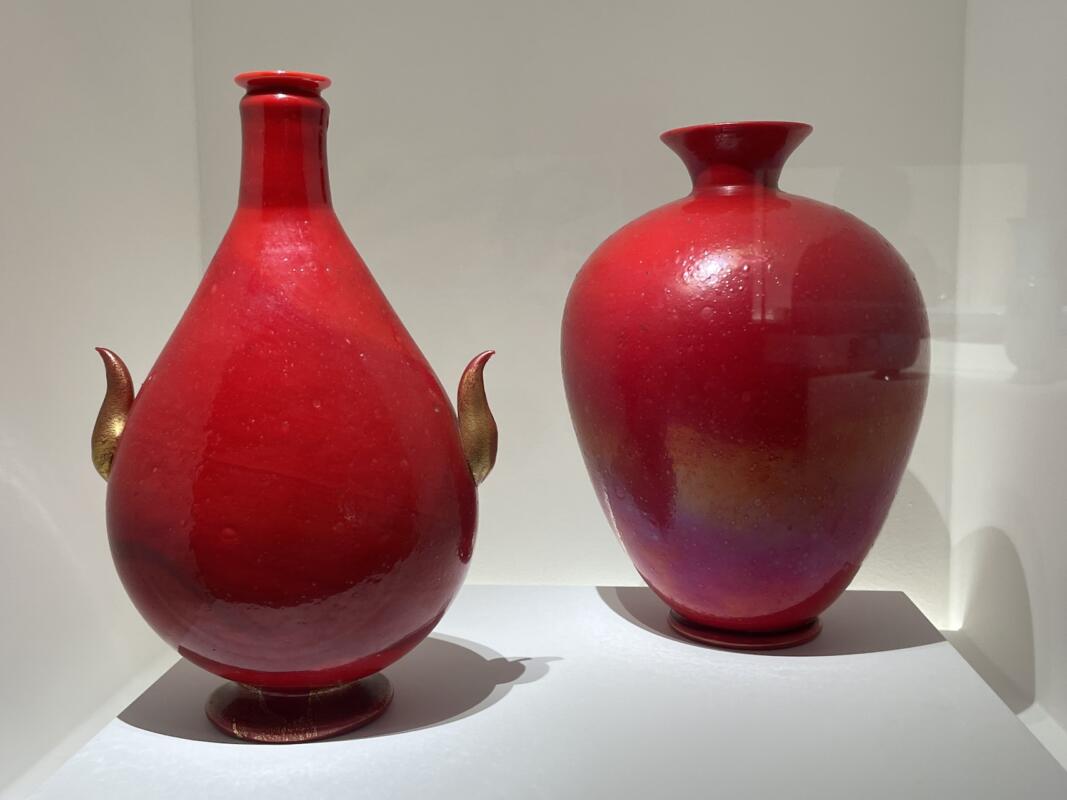
Standing out among the furnaces was Venini in particular, which availed itself of the collaboration of Carlo Scarpa. In 1934 and 1936 suggestive variants of heavy glass were proposed at the Biennale with the “Sommersi a bubbly” and the “Corrosi,” with extraordinary chromatic effects, while in1940 of great importance were the opaque murrine bowls, with intense coloring, for which Scarpa resorted to grinding, obtaining a polished surface that contributed to the uniformity of the material and design. Cold-working, such as grinding and etching, was also employed for the finishing of thick, multi-layered clear glassware, which in some cases is distinguished by the presence of horizontal etchings or characteristic decorative motifs such as wave patterns. At the 1942 Biennial, on the other hand, mostly blown glass decorated with threads, horizontal bands or irregular polychrome decorationsstood out on the transparent surface. There are also deliberately irregularly shaped transparent bowls with abstract patterns in sapphire and black, as well as thick vases in corroded glass and others of elongated shape made with vertical canes, and then there are light and transparent ones in half filigree and others in black and red lacquered glass. For Zecchin Martinuzzi, Napoleone Martinuzzi elaborated his research in the field of glassmaking by favoring the use of encased glass and glass paste with intense colorations. In 1934 he exhibited some fifteen vases and bowls in encased glass finished by iridation or by applications of gold leaf, or with animal and plant faces. Along with these were also presented vases and cups in iridescent coral red, sometimes with gold leaf, with a textural appearance and essential volumetry.

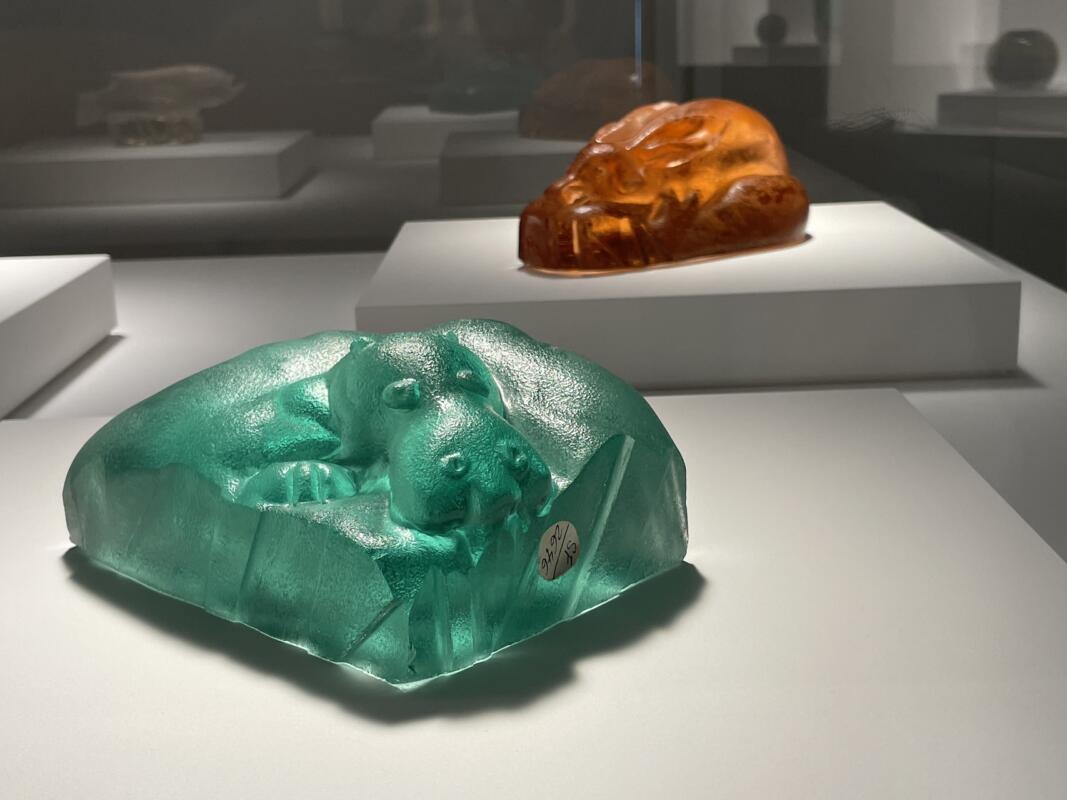
Among other furnaces where collaborations with designers and artists increased, Salviati & C. has been present in the Venice pavilion since its opening with glass designed by Murano painter Dino Martens and in 1936 with works by painter Mario De Luigi. The latter in particular nurtured an interest in mosaics, from which he drew inspiration for a series of glass pieces, as also demonstrated by “Il bagno,” a panel with glass tesserae by Fratelli Donà made by the artist together with his friend Carlo Scarpa and exhibited in 1932 at the opening of the Venice Pavilion. Also standing out as fine artifacts are those of Barovier Seguso & Ferro, conceived by Flavio Poli, artistic director since 1934, who for the series of gold-gray encased glass used the collaboration of master Alfredo Barbini. Submerged glass artifacts are also offered on this occasion, including a spherical vase with layers of bullicant, a decoration with dense bubbles arranged in a regular manner, obtained with a technique devised by master Archimede Seguso. In 1938 the glass exhibition includes, among other things, a series of glass Poli animals executed in solid form and obtained from a single block of broadly molded glass, among which appear a cute green corroded glass hippo and an orange rabbit.
C.I.D. s.r.l. Società a Socio Unico – Casa editrice del settimanale Gente Veneta – CF e PI 02341300271 – REA: VE – 211669 – Capitale Sociale 31.000 euro i.v. – Dorsoduro,1 – 30123 Venezia
Iscriviti a VE-NICE e non perderti nessun aggiornamento, ti invieremo 1 volta a settimana i nuovi articoli!